Sunday, 8 April 2012

Saint Aldhelm, Bishop of Sherborne-Sarum


Saint Aldhelm (Ealdhelm) was born about the year 639. He is said to have been the son of Kenten, of the royal house of Wessex. He received his education from the Irish monk-scholar Maeldubha, after whom Malmesbury is named. Aldhelm was one of the disciples of Abbot Adrian of Canterbury. His studies included Roman law, astronomy, mathematics, and difficulties of the calendar. He learned Greek and Hebrew. Ill health compelled him to leave Canterbury, and the Saint returned to Malmesbury Abbey, where he was a monk under Maeldubha for 14 years. When Maeldubha reposed, Aldhelm was appointed in 675 to be first abbot of Malmesbury.

Aldhelm introduced the Benedictine rule, and secured the right of the election of the abbot to the monks. The community increased, and Aldhelm was able to found two other monasteries: Frome, Somerset and Bradford on Avon, Wiltshire. The little church of St Laurence at Bradford on Avon (photo below) dates back to his time, and is probably his. At Malmesbury he built a new church and obtained grants of land for the monastery.


His fame as a scholar spread to other countries. Artwil, the son of an Irish king, submitted his writings for Aldhelm's approval, and Cellanus, an Irish monk from Peronne in Gaul, was one of his correspondents. Aldhelm was the first Anglo-Saxon, so far as we know, to write in Latin verse, and his letter to Acircius (Aldfrith or Eadfrith, king of Northumbria) is a treatise on Latin prosody for the use of his countrymen. In this work he included his most famous productions, 101 riddles in Latin hexameters. Each of them is a complete picture, and one of them runs to 83 lines.

His fame as a scholar reached Italy, and at the request of Pope Sergius I, abbot Aldhelm paid a visit to Rome. He was deputed by a synod of the church in Wessex to remonstrate with the Britons of Dumnonia (Devon and Cornwall) on the Easter controversy. British Christians followed a unique system of calculation for the date of Easter and also bore a distinctive tonsure; these customs are generally associated with the practice known as Celtic Christianity. Aldhelm wrote a long and rather acrimonious letter to king Geraint of Dumnonia (Geruntius) achieving ultimate agreement with the Patriarchate (Rome).

In 705, or perhaps earlier, Hedda, bishop of Winchester, reposed, and the diocese was divided into two parts. Sherborne was the new see, of which Aldhelm reluctantly became the first bishop in 705. He wished to resign the abbey of Malmesbury which he had governed for 30 years, but he yielded to the remonstrances of the monks and continued directing it until his death. Though he was now an old man, St. Aldhelm was very active as a Bishop. He built a cathedral church at Sherborne, described by William of Malmesbury. St. Aldhelm was known for singing hymns and passages from the gospels, interspersed with entertaining tales, in public places so that he might draw attention from the crowds and then preach to them. For this, he is known as the Apostle of Wessex.

St. Aldhelm fell asleep in the Lord in the church of Doulting on 25 May 709. His holy and venerable body was taken to Malmesbury, and crosses were set up by his friend, St. Egwin, Bishop of Worcester, at the various stopping-places. The Saint was buried in the church of St. Michael at Malmesbury Abbey (photo below). His biographers relate miracles worked during his lifetime and at his shrine. He was revered as a saint after his death, and his feast on May 25 is found in the Sarum Missal.


Holy Father Aldhelm, pray to God for us

Source: http://www.allmercifulsavior.com/icons/Icons-Aldhelm.htm

Saint Andrew the first-called Apostle, Patron Saint of Scotland († 62)


The Cross of Saint Andrew - the blue and white emblem of Scotland's patron saint - is believed to be the oldest continuously used flag in the world. Simple in its design, it has withstood centuries of political and religious turmoil, and remained the standard for Christian Scots, as well as those who have forgotten the reason their banner bears the Cross. (For the record, Saint Andrew was martyred on an X-shaped cross). Like the people for whom it flies, Saint Andrew's Cross has proven its resilience and strength.

The endurance of Saint Andrew's Cross is seen in the presence it still has in Scotland's largest emigree nation - Canada. In a country whose first Prime Minister was a MacDonald, whose first woman Prime Minister was a Campbell, and which boasted no fewer than nine Prime Ministers of Scottish ancestry (only five Prime Ministers were French), it is not a stretch of the imagination to suggest that Scotland still has at least a pint or two of its own running through the bloodstream of Canadian culture. Official ceremonies, academic awards, university names and traditions, along with the pipers who lead their processions - all these have been inherited from the practices of the Celts of Scotland, through their Canadian children.


The Cross of Saint Andrew can be found on 5 Canadian provincial flags, either within the Union Jack, or in the mirrored image of the flag of Canada's New Scotland, Nova Scotia. Yet those who trace their roots from that chilly isle to this great land do not often read back far enough to discover the essence of Scotland's Celtic roots, roots that reflected the faith of Saint Andrew for nearly one thousand years in a Celtic Church that was vibrant, independent, and fully Orthodox.

For those who entertain new-agey illusions about the Celtic Church, there is bad news: Celtic Christian worship was in most ways very similar to the life of Orthodox parishes today. What is very clear, Celtic Christians had far less in common with the free-wheeling nature worship one might find in certain Protestant or Roman Catholic circles than it did with the spiritual life of Greek monasteries in Byzantium. This shouldn't surprise us: the Greeks and the Celts had the same faith and liturgical life, while the Christian Celts and the modern western confessions, distorted by the Great Schism and the Protestant Reformation, do not.

In his classic book, Liturgy and Ritual of the Celtic Church, F.E. Warren thoroughly outlines this common spiritual inheritance. Concrete examples are numerous. Celtic Christians fasted on Wednesdays and Fridays, the universal observance of the Church in the first millennium. They rejected the claims to universal authority that Popes of Rome often claimed over Church decisions in custom, belief, and practice, and resisted innovative changes to early Church practices, including the Church calendar. The Celts observed a highly ascetical life, strongly shaped by the widespread presence of monasteries, where monks and non-monastics alike would say the services of the Hours on a daily basis.

The presence of married priests among the Celts did not arise out of a special dispensation from Rome, but rather, from the Celtic Church's independence from Rome. Around 400 A.D., the Celtic Church was large enough to attract the attention of Saint Jerome, who noted that the Celts were in communion with Rome, Gaul, and Africa - part of the universal witness to the One Faith. At the Sixth Ecumenical Council, Saint Wilfred affirmed the Orthodoxy of the Celts, despite the concerns of their critics that some local Celtic customs were at variance with Rome. Saint Columbanus, the great champion of the independence of the Celtic Church, repeatedly upbraids the Roman Church for its claims to universal authority - the timeless Orthodox defense against the extension of papal powers. "Let no bishop leave their diocese," he thunders, "lest he interfere with the affairs of the Church."
Saint Wilfred Saint Columbanus

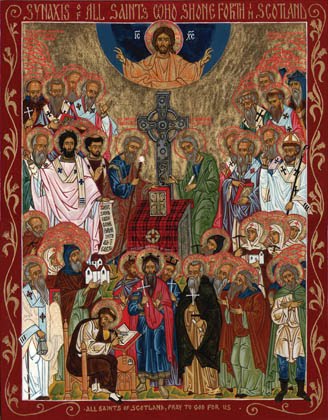
Synaxis of All Saints who shone forth in Scotland

Saint Donald Saint Columba Saint Cummian Saint Donan

Saint Ninian


The artistic life of the Celtic Church shows a warm interplay between the images of the universal Orthodox witness, and local Celtic traditions. Architectural decoration, ribbons in stone carvings, and giant initial letters in manuscripts reflect a North African influence, a fact not lost on most modern authorities on the Celts. The use of icons, and iconostases, were seen in various Celtic churches, including the burial place of Saint Brigid, the great Celtic saint. Celtic depictions of Christ as a child, wrapped in mummy-like swaddling bands, reflect Egyptian and Byzantine iconography. Like Orthodox bishops today, Celtic bishops used staves bearing the heads of snakes, like Moses in the desert. We can only imagine how much more we would know if the persecutions of Diocletian (305-313AD) had not destroyed many churches in the Celtic diaspora on the European continent (the earliest Celtic Church dated from around 200 A.D).

Liturgically, the Celtic Liturgy will seem familiar to Orthodox Christians, which is not a surprise in light of the fact that it represents one of the oldest Orthodox liturgies. The celebrant faced the altar, behind an icon screen, offering up the sacrifice of the Holy Mysteries of Communion with both elements together in the chalice. Communion was almost certainly delivered on a spoon; many such spoons have been found. A little water was added to the chalice before Communion, just as it is in the Liturgy of Saint John Chrysostom. There was even use of a small Eucharistic knife or spear, used for dividing Communion before it was placed in the chalice.
The souls of the departed were uniformly commemorated at the Liturgy, with long lists of saints, both local and universal, named at the services (there is some suggestion that the Celts did not ask for specific prayers from the saints; their general intercessions were assumed). The episcopal blessing, at Liturgy and perhaps other times, was bestowed in the manner of the Greek Church, with the fingers of the celebrant in the form of the Christogram (IC XC):


A variety of other liturgical parallels exist. Women were always veiled in the Celtic Church for the reception of Holy Communion. It is known that the Celts served at baptism an unction with blessed oil (as well as chrismation), and performed a ritual washing afterwards, much like the Slavic churches do to this day (the Greek custom of covering a newly baptized child with olive oil is an expansion on this practice, which works very well in Mediterranean climates, but which finds its limits in chilly northern climes). There is some suggestion that the Celts celebrated the Liturgy without wearing shoes, in the manner of the Copts of Egypt (just like the North American saint of our time, Saint John Maximovich). Noting the Celtic monastic connection with the Copts, this would come as no surprise.

It should not surprise us to find these similarities, since in comparing the Celtic Church to the Church in Byzantium, or to Orthodox Christianity today, we are in fact comparing the Church to itself. The Orthodox Christianity of the Apostles, of the Ecumenical Councils, of the Byzantines, the Slavs, the Arabs, and the Celts - it is one faith, not many. The Celtic Church was astonishingly similar to Orthodox life today - because it was Orthodox.

The inheritance of Saint Andrew, whose proud banner waves in front of many a Presbyterian church in Canada, is not to be found inside these churches. Nor is the bold heart of the Celtic Christians of Scotland to be found at Burns dinners or chip shops or the Lodge of the Scottish Rite. The banner of the Celts is an Orthodox Christian one; it always has been. And it is a banner that flies proudly in the hearts of hundreds of thousands of Canadians, who still await the rediscovery of their own Orthodox Celtic roots, which cannot be found in the western confessions. These confessions of the last thousand years would have been virtually unrecognizable to the Celts of a millennium ago - the same Celtic Christians who would feel right at home in any Orthodox church in North America today.

Canada's first Scottish leader, Prime Minister John A. MacDonald, lies buried in the cemetery of a parish church in Kingston, Ontario, the same building that is home to the Orthodox Community of Saint Gregory of Nyssa. Perhaps it is in such a representation that we can rediscover the heritage of the founders of our own nation, its own enduring and brave Orthodox roots, put down in Celtic lands by the same Orthodox monastic saints who once made pilgrimage across the ocean to our own land. For it is only these roots that will keep Saint Andrew's banner long and gloriously waving - not just in our hearts, but in our lives.
____________________________________
Background note: The St. Andrew's cross is a distinctive shape because the Apostle Andrew, who would later become the patron saint of Scotland, asked that he not be crucified on a cross of the same shape as that on which Jesus Christ was executed. (See the Great Synaxarion of the Orthodox Church, November 30th)

The legend of the birth of the Scottish flag takes place circa AD 832 near Athelstaneford in East Lothian. Angus mac Fergus, King of the Picts, and Eochaidh of Dalriada faced off against the army of Athelstane, King of Northumbria, comprising Angles and Saxons. On the eve of the battle, it is said that the Scots saw the clouds in the evening sky arranged in a formation exactly like that of St. Andrew's cross. The Scots saw this as a harbinger of their victory. When they were victorious the following day, they adopted a white St. Andrew's cross on a field of azure blue as their national standard.
Father Geoffrey Korz, (Dormition, 2007)
=========================================================================
Troparion (Tone 4)
Andrew, first-called of the Apostles
and brother of the foremost disciple,
entreat the Master of all
to grant peace to the world
and to our souls great mercy.
Kontakion (Tone 2)
Let us praise Andrew, the herald of God,
the namesake of courage,
the first-called of the Savior's disciples
and the brother of Peter.
As he once called to his brother, he now cries out to us:
"Come, for we have found the One whom the world desires!"
Source: © All Saints of North America Orthodox Church
Orthodox Church in America, 2007.
http://www.orthodoxcanada.com/

THE ORTHODOX PRESENCE IN WALES

Prepared by Constantine Nafpliotis

The Welsh are descendants of the ancient inhabitants of Britain, long before the arrival of the Angles in the 5th century. The Welsh language also has its roots in the language of the ancient British and there is an actual unbroken tradition that reaches as far back as the ancient time of existence of that language. To a large degree, the language is deeply Christian, as proven by the numerous medieval odes in honour of Orthodox Welsh Saints, as well as by a rich hymnography.
Wales takes up an area of western Britain. Its western coast is washed by the Atlantic Ocean and to the east it borders with England. Its population is 2.5 million. In 1282 Wales lost its independence and has since been governed by England. In 1999 – and for the first time after 700 years, following a Referendum in all of Wales – the country has once again acquired its own Senate and can now take the initiative and responsibilities for its own life.
At this very critical moment of Wales’ History, the Orthodox Church (which was once the Church of the Welsh Nation) has an opportunity to call the people of Wales to return to their historical spiritual roots: to Orthodoxy.
THE HISTORY OF CHRISTIANITY IN WALES
Christianity came to Britain during the 1st century A.D., upon which immediately began the evangelization of the Celts (who were the first inhabitants of Britain). Saint Aristobulus of the Seventy Apostles is regarded as the Apostle to Britain.

A flourishing Celtic Church - Orthodox in faith and in practice - takes root in Britain and brings forth a cloud of Saints, especially during the 6th and 7th centuries. Savage, idolatrous tribes from the European mainland invade Britain, and the Christian Celts move away towards the north and the east to safer territories - to what is known today as Wales and Scotland.
In 596 Saint Gregory the Pope of Rome sends Saint Augustine (of Canterbury) to proselytize the newcomers who had invaded Britain. The roman mission came in contact with the local British church and gradually "absorbed" it and placed it under the jurisdiction of the English Archbishopric of Canterbury and thereafter, under the authority of Rome.

In 1282 Llywelyn the last Prince of Wales is assassinated and Wales loses its political independence.
In 1536 Henry VIII - the 8th king of England - annexed Wales to England once and for all. He proclaimed himself Head of the Church of England (the Anglican Church) and broke away from Rome. His chief administrator and legal advisor, Thomas Cromwell, destroyed Monasteries, pilgrim sites and Temples with Holy Relics throughout England (1536-1539). By degrees, the Church of England became Protestant in faith and in practice.

In the 18th century the Anglican Church was spiritually very strong. It was for this reason that the Methodists prevailed, especially in Wales: because their theories, combined with Calvin's theology, somehow suited the Welsh mentality.
During the second half of the 20th century, a steep decline in Protestantism appeared in Wales. Temples gradually emptied, however, Calvin's theories had influenced the people's psychology and had alienated them from the Church - and naturally from God.
In 1973 Archimandrite Barnabas - the first Welsh Orthodox priest after the Great Schism - returns to his native land to live the monastic life and embarks on his missionary labours, through to his repose in 1996, at the age of 80.

In 1979 the Abbot Deiniol (Daniel) - another Welshman - is ordained an Orthodox priest and takes on the mission in Wales.
In 1998 fr. Luke, an Englishman, is ordained and serves in southern Wales.
In 1999 Wales is officially recognized as a nation; following a referendum, it acquires its own Parliament. The Orthodox Church is officially invited to participate in the parliamentary commencement ceremony, with the request to offer up a special prayer to the Lord through the intercession of all the Welsh Saints - an act that was prohibited by the Protestants - until now.
THE ORTHODOX MISSION IN MODERN WALES
In 1973 Archimandrite Barnabas returns to his native land with the deep desire to found a monastic brotherhood dedicated to the Prophet Elijah. His desire was not fulfilled for various reasons. He was always possessed by the zeal to preach the Orthodox faith in his homeland, and laboured tirelessly towards that goal, right up to the end of his life. He daily performed all the services and joyfully offered hospitality to the many visitors in the monastery that he had built. He published an informative periodical, he preached, and he always responded to invitations from all over Wales, and also outside it. He was well known and respected by everyone in Wales. He frequently spoke on radio programs and many Welsh heard about Orthodoxy for the very first time - and in fact in their native tongue - by a priest who was a fellow-countryman. At last! An Orthodox priest - the first after the Great Schism of 1054 - who laboured in Wales as a missionary!
After the repose of fr.Barnabas, the Monastery of the Prophet Elijah remained closed. It is a fact that its location (near the English borders) is not a suitable one. It is not located in the heart of Welsh society with its linguistic homogeny and its genuine tradition - an element that the Orthodox Church needs to pay close attention to, if it wishes to take root in Wales.
In the southern parts of Wales there have been several Orthodox Christians, several years before the Orthodox Church's revival. They were mostly Greek women who had married Welsh soldiers during the War and had come to live in their husbands' homeland, where they eventually raised their families. Their desire was to baptize their children in the Orthodox Church. Little by little, some of the locals began to discover the Orthodox faith and to eventually join the Orthodox Church.
The town of Blaenau Flestiniog is situated approximately in the centre of the nation, on a central road that spans Wales from the south to the north. In this town there used to be an Orthodox temple of the Holy Protection, on a breathtaking slope of Mount Manod (photo below).

It was in this church that fr. Deiniol (Daniel) was posted immediately after his ordination in 1979 and where he attempted to congregate the Welsh faithful. Basically, the local language was used during Worship, but also used were English, Greek and Slavonic. But it was for the first time in modern-day history that an Orthodox community began to grow, and with the use of the Welsh language.

The Church in Wales - Yr Eglwys yng Nghymru


The Parish of Blaenau Ffestiniog Diocese of Bangor

"Generally speaking, the town is poor and quite depreciated. Its population of 12.000 citizens has been reduced to 4.500, and with a high percentage of unemployment. We shall also in the future continue to be poor, unemployed, and with countless difficulties. The young are deprived of prospects and a purpose to their lives; but we do believe that the Christian Church is the future of our society.
"In 1995 we began our intensified and systematic missionary work.
"In 1996 and with the blessings of our Bishop, the Orthodox Mission of Wales was officially recognized; its main opus being to call upon all the Welsh to return to the Orthodox faith.
"The people in Europe believe that they know Christianity; but quite often they are misguided, because theirs is not a knowledge of Christianity; rather, it is a caricature of Christianity. Fr. Barnabas used to say that the people in the West had so much Christianity, that they.... were impervious to it!
"However, we believe that it is now time for the Europeans to acquaint themselves with the Gospel of Christ, not their own religions, and with the sacramental life of the Church. That is the scope of our missionary endeavour also.
"In Wales, apart from the difficulties that the entire population of Europe has - i.e. materialism and overspending - there are also certain other problems:
- Centuries of Calvinism in Wales have made the people believe that God is NOT a loving Father but a tyrant Whom they must fear.
- The Protestant dogmas also played a role in splitting society into "the just" and "the sinners", and caused many people to be regarded as outcasts.
"In the face of this mentality, it is imperative for the Church to preach the love, the joy, the acceptance and the forgiveness that God offers. This is the direction in which the Orthodox of Wales have turned their endeavours. The ecclesiastic hymns that were recorded on tapes in our language had a hugely positive response. It was also very important for us to have hagiographic icons of the Saints of our land. All the Christians want to have them in their homes. Most of them were produced by the hagiographer Gregory Papageorgiou from Cyprus. (St.Dewi icon below)

DEWI SANT, Patron Saint of Wales.
Icon by G. Papageorgiou
at the Orthodox Church of the Holy Protection, Blaenau Ffestiniog

"The first icon to be fashioned was that of Saint Cadwaladr, followed by Saint Lestyn the Monk, Saint Melangell the Abbess (now known in Greece also), Saint Pabo the King, Saint Εilian the Pilgrim, and Saints Cybi and Seiriol who founded monastic brotherhoods on the islands of northern Wales. Christmas cards with Welsh saints, as well as several pamphlets with the lives of saints - including Saint Nectarios - were printed, in the Welsh language.

St. Melangell St. Teilo St. Gwynog St. Twrog St. Deiniol

St. Cadfarch St. Tyssilio St. Eilian St. Cadoc St. Paul Aurelian

Saints Cybi and Seiriol

Holy Hierarch St. Owen St. Tudwal St. Pabo Post Prydain St. Tydfil St. Winifred
"In our missionary work, we made use of the mass media, with homilies, discussions on matters of the faith and the life of the Church. Many people nowadays watch televised programs that concern the Orthodox Church; they read related articles in local newspapers and they attend lectures and public discussions on the Orthodox Church and Faith. School children, college students, various groups of young or old visit the Orthodox temple where the rector, fr. Daniel answers their innumerable questions. Those visits always end with the Minor Paraclesis (prayer of supplication) addressed to the Holy Mother Theotokos.
"Many are the daily opportunities that we are given to minister to the people of God, from within that temple in the town of Blaenau. In accordance with the tradition of our Church, we strive to serve the people of our local community and especially those who live isolated, disillusioned, marginalized - in their very homeland, and even in their own families. This ministry brings us in touch with people who are suffering, unemployed, abandoned, homeless, with broken families... basically, with a host of social problems. To all of them, we desire to bring the message of the Orthodox Christian Faith and the fulfilment of the Eucharistic life, which is none other than the Kingdom of God.
"In July of 1999 our Bishop informed us that a new church will be built in Βlaenau, which will be dedicated to "All Saints of Wales". This message was to us a source of great joy. Archimandrite fr. Zenon - a major Russian hagiographer - promised to fashion the Icon of All Saints of Wales. With a missionary spirit strengthened by the intercessions of all our Saints - who were themselves missionaries - we believe that this is how we too shall continue. And in the words of our Bishop: "The parish must become a beacon of Orthodoxy, which will shine upon all the people in Wales."
"After one thousand years, Orthodoxy has finally returned to Wales and our Church commenced Her missionary work in a land that has been Orthodox from the first centuries A.D.. The Welsh people are invited to return to their roots, to the Faith of their Saints, to their sources, to the upright faith and practice.
Translation: K.N.
=======================
(A news item from the Orthodox website: http://southern-orthodoxy.blogspot.com/)

Jan 24 2005, Rhodri Clark, Western Mail

A CHURCH in North Wales could be decorated with frescoes of hundreds of Welsh saints to cement its links with ancient Celtic Christianity.

The long list of Welsh saints includes each one commemorated in a place name starting with "Llan", as well as St Patrick and others remembered mainly for their work outside Wales.

Father Deiniol, who founded the Wales Orthodox Mission more than 20 years ago, said there were so many saints that there would not be enough room in his Blaenau Ffestiniog church for each one.

"We could include one from every part of Wales," said Fr Deiniol, known locally as Y Tad Deiniol.

A religious artist in Colwyn Bay has expressed interest in the job, but would first have to learn how to paint icons in the traditional Orthodox style.

Fr Deiniol has decided against building an onion tower - a powerful symbol of Orthodox churches in Russia and elsewhere - on his former Anglican church in Blaenau Ffestiniog.

"We thought about that once but we asked, 'What would that be saying?' It's very foreign. We're not Russians or Greeks, we're Welsh. The onion tower is not part of our tradition."
He is chaplain in Bangor and Aberystwyth, where some of the university students are from Greece, Russia and other countries with a predominantly orthodox faith. Services at his church in Blaenau Ffestiniog can attract up to 300 people at key festivals in the calendar such as Easter.

The history of Fr Deiniol's mission will be retold in an hour-long documentary on S4C on Tuesday, February 1, 2006.

Source: http://clubs.pathfinder.gr/emmaous/149004?read=231&forum=20591

Thursday, 29 March 2012

EARLY SAINTS OF THE ANCIENT KINGDOM OF DUMNONIA

The original icon (above) of Our Lady of Glastonbury hangs in the Chapel of Saint Simeon & Saint Anna, Combe Martin. It was painted by Fr David (of blessed memory) founder of the Orthodox Brotherhood of Saint Seraphim at Walsingham. It depicts the Mother of God and Her Son. Christ holds the universe and the Holy Thorn. Also represented are the Archangel Michael, Saint Aristobulos, Saint Joseph of Arimathaea, Saint Patrick, Saint Brigid, Saint Beon, Saint Indracht, Saint Fili, Saint Kea, Saint Ruman, Saint Domenica, Saint Collen, Saint Gildas and Saint David, all of whom traditionally have associations with Glastonbury.
Ruins of Glastonbury Abbey (early 6th century A.D.)
Saint Rumon - 5th January
According to Glastonbury's list of relics Rumon was a son of the King of Brittany. He was born in the early sixth century and probably studied the Scriptures in Ireland, returning to Britain with St Breaca.
Although he is the patron saint of Tavistock and was a companion of Sts Fili and Kea and features with them on our Glastonbury icon, the stories of his life have him in Brittany. There he built a hermitage and local peasants and grandees alike sought his advice. When he died his body was originally buried in Brittany. According to Sabine Baring-Gould his relics were brought to Britain for safety during the Viking raids in the early tenth century. In 960 they were brought to the newly founded Tavistock Abbey and there they worked miracles until the monastery was dissolved by Henry VIII.
Tavistock Abbey (founded in 960 AD - plundered and burnt by the Danes in 997 AD)
Saint Gildas - 29th January
St Gildas came from the Clyde area, son of the northern King Caw. He was educated in the south then returned home to do missionary work, which later took him to Wales. Not only was he a monk but also a historian - mostly remembered for his work 'De Excidio Britannae'.
Some stories associate Gildas and his family with King Arthur, with whom there was a long-standing feud, which was finally settled with the help of St Cadog.
St Gildas lived much of his life as a hermit, for a while on the island of Flatholm in the Bristol Channel and finally in Street, then known as Llantokey, where he died on 29th January 570 and was buried in Glastonbury Abbey.
Saint Brigid - 1st February
St Brigid was born in Ireland in 452 to a Christian mother who was a slave of her father, the pagan chieftain of Leinster. Brigid suffered hardships as a child but she remained cheerful and was kind both to people and to animals.
Like her mother she worked for her father in the kitchen and dairy and gave away food to the poor. When her father protested she replied, "Christ dwelt in every creature". He tried unsuccessfully to sell her to the King of Leinster and eventually gave her freedom.
Brigid refused good offers of marriage and instead founded the first women's monastery in Ireland at Kildare, so called because it was under a giant oak tree and was known as the 'church of the oak', or Cill Dara. This monastery became a centre of religion and learning. Brigid also founded a school of art, which became famous for illuminated manuscripts, as well as continuing to help the poor and the sick.
Whilst comforting a dying pagan with stories of Christ, she unwittingly wove a cross from the rushes that covered the floor. This simple rush cross known as St Brigid's Cross is still made in Ireland and placed in the rafters of houses on her feast day.
According to the Book of Lismore, St Brigid was 'abstinent, she was innocent, she was prayerful, she was patient; she was glad in God's commandments; she was firm, she was loving; she was a consecrated casket for keeping Christ's Body and His Blood; she was a temple of God, her heart and mind were a throne of rest for the Holy Spirit.'
Brigid died on 1st February 525 in Kildare. Bridestowe parish church, near Okehampton is dedicated to St Brigid.
Saint Ia - 3rd February
St Ia was born in Ireland in the fifth century and later came to Cornwall. She should have come with St Fingar and his companions but they set off without her. Obviously her mission to Cornwall was pleasing to God because miraculously a large leaf appeared to take St Ia on her journey, and although she left after St Fingar's party she arrived before them. She spent many years doing Christ's work before she was martyred along with other missionaries.
Saint Piran - 5th March
St Piran is another fifth century saint of Irish heritage. He spent his youth in South Wales where he became friends with St Finnian and the two men returned to Ireland together.
As an old man in Ireland, St Piran was captured by local pagans who were jealous of his power to heal. They put a millstone round his neck and threw him off the cliffs into a raging sea. As soon as he hit the water the seas calmed and the millstone became like a cork, which he used as a raft and set sail for Cornwall. He landed at Perran Beath and built an oratory at St Piran-in-the-Sand.
According to Geoffrey of Monmouth St Piran became chaplain to King Arthur at Tintagel.
St Piran became popular in Cornwall because he provided the people with a profitable living. Having made a fireplace from a large lump of black rock, he noted that as the flames grew hot a trickle of pure white metal (tin)oozed from it. This white trickle on a black rock is symbolized in the Cornish flag: a white cross on a black background.
Saint Petroc - 4th June
St Petroc was the son of a Welsh king, but he refused to succeed his father. Instead he and his retainers became monks. He spent some time in Ireland before going to Cornwall. He landed in the Camel estuary with a group of companions (Sts Croidan, Medan and Degan whose memories we also keep today) and travelled to Padstow. On the way he met some men working in the fields and asked them what their religion was. Not being a couth bunch and wanting to test Petroc's holiness they said they were thirsty and asked if he could make a rock produce water. Petroc hit the rock with his stick and out came pure fresh water, and this spring has never dried up.
Petroc lived in Cornwall for thirty years, founding a monastery in Bodmin where he observed a strict and severe rule - spending nights in cold rivers and eating a very meagre diet of bread and on Sundays, because it is the day of the Resurrection, a few pulses. He was a great lover of animals and his saving a stag from huntsmen led to King Constantine of Cornwall being converted to Christianity, and later dying as a martyr.
St Petroc was also a great traveller. He went on a pilgrimage to Rome and then to Jerusalem. From there he set out for the East, to India and beyond before returning to Cornwall seven years later.
On 4th June 564 Petroc succumbed to the rigours of his ascetic life and constant missionary work and his body was interred at Bodmin. But Petroc's travels didn't stop there. After the feast of the Epiphany in 1177 a Breton priest stole the body and took it back to Brittany as a gift for the Abbey of St Meen. The prior of Bodmin appealed to Henry II who ruled Brittany at that time and the monks of St Meen relinquished the relics and they were returned to Bodmin in an ivory casket, which itself was stolen only a few years ago.
Saint Nectan -17th June
St Nectan was born in 468, the eldest son of a Welsh king, and had twenty-four brothers and twenty-four sisters. He was inspired by the life of St Anthony of Egypt and became a hermit. He left Wales intending to live wherever his boat landed, which was at Hartland Point. At nearby Stoke he built a church and a hermitage and lived a solitary life, except for his brothers' and sisters' annual visit after Christmas.
In 510 Nectan was given two cows by a swineherd for helping find his lost pigs. On 17th June that year two robbers stole the cattle, but Nectan tracked them down and tried to convert them. In their turn the thieves cut off Nectan's head. Nectan picked up his head and went home. It is said the dark pink foxgloves that line the verges in June grow where drops of his blood fell. Back in Stoke he laid his head upon a rock by a well and died.
Saint Brannoc - 26th June (in Braunton & North Devon, 7th January elsewhere)
St Brannoc lived in the sixth century and was tutor to the children of King Brychan of Wales. He left Wales for several years, first travelling as a pilgrim with the king to the Tomb of the Apostles, then spending some years in Brittany where he founded many churches.
He is said to have come to North Devon floating on a stone coffin and first settled in a cave in Mortehoe. He built his first church in the area where St Brannoc's Well is now, but it fell down. In a vision he was told to build a church where he found a sow and five piglets, and he found them in the village of Braunton. Having settled in Braunton he spent his life teaching holiness and husbandry.
Saint Urith - 8th July
St Urith lived in the 7th century. She was born in East Stowford, near Barnstaple and converted to Christianity by St Kea. She lived as a hermit in nearby Chittlehampton, where she founded a church. At the behest of a jealous, and pagan, stepmother some female haymakers killed Urith with a scythe. The moment she fell to the ground and died a spring appeared at that place. She was buried in the church she founded.
From that moment her shrine became a popular place of pilgrimage - Chittlehampton church owes its tower to the pilgrims' donations. As with so many of the country's other sacred sites, her shrine was removed during the Reformation and veneration of her relics forbidden.
Chittlehampton Church - near Devon
Saint Sidwell - 2nd August
In the county of Devon, in a city called Exeter after the river that flows through it, there lived a man of noble birth and virtue by the name of Beorna. He had one son and four daughters - one of whom was recognised to be of great goodwill in the Lord; her name was Sidwell. Nature and grace so worked together in her that they conferred on her a title of praise for beauty of form and moral integrity. But since the good are often persecuted by the jealous, and traps are sometimes laid for those having good fortune, after the funeral of her mother she was soon falsely ensnared by a stepmother's hostility.
Thus, Sidwell was persuaded by a stepmother consumed with greed to go out through the city streets and beyond into the fields of which this schemer planned to rob her, harbouring in her breast a wicked plot to murder the holy girl. And so one day the serfs mowing meadows outside the city walls were induced by her to undertake a deadly attack on the virgin the following day, when she would come by herself to bring them food. Seduced by the hope of reward, the serfs agreed, promising to carry out the woman's instructions.
Next day the virgin, holy and guiltless, carrying down the food by herself to the meadows that were being mown, was sent by her stepmother to execution. As the virgin came near, these most wicked serfs drove their scythes through the neck of the innocent one. While approaching however, she had forebodings of her death; she calmly handed them their food and fortified herself with prayer. Her head cut off, she rendered back her spirit to her Creator.
Now the Divine Mercy, which distributes gifts of different kinds, not hesitating to make manifest the purity of virginal innocence caused the clearest of springs to well up in the place where the virgin's blood spattered. Seeing this, the butchers wanted to conceal the villainy they had perpetrated; and although unable to cover the spring with grass, they tried to hide the body. But lest through their silence she should be robbed of her title to sanctity, the city watchmen on their nightly rounds saw a brilliant shaft of light from out of heaven shining over the virgin's body. This they saw for three nights; and on the fourth night following, to their dread, they saw the body of the virgin herself, surrounded by a radiance, carrying her severed head in her hands, from the place of her martyrdom to the place where the faithful Christian community subsequently built the virgin's church. Here in the morning, prompted by the heaven-sent sign, the people came in haste and found the virgin's head, not rolled elsewhere but joined to the body, just as if it had been placed there by the care of the faithful. So she was buried in that very place, Christ's martyr Sidwell, by whose merit into our own times, the lame walk, the blind see, and a multitude sick with various diseases find healing and perfect health.
(From Legenda Sanctorum by Bishop John Grandisson of Exeter 14th Century)
St Winifred - November
St Winifred, St Gwenfrewy in Welsh, was the daughter of a rich Welsh Lord. Wishing to escape the attentions of some young princes, she moved away with her uncle, St Beuno, to Abeluyc.
One day when Winifred was left alone in the house whilst everyone else had gone to church, King Caradog stopped at the house. He was very taken with Winifred's beauty, but she was not taken with his advances and rejected him, whereupon he tried to use force. Winifred fled to towards the church and the furious Caradog chased her. On the steps of the church Caradog cut off her head. Immediately, a spring of pure, clear water appeared where her head fell.
St Beuno rushed from the church and taking her head he set it back in its place. Then he and the congregation prayed that she would be restored to life. Their prayers were answered.
In thanksgiving, Winifred decided to devote her life to Christ, first staying in the church at Abeluyc with eleven maidens to whom she gave religious instruction.
After a pilgrimage to Rome she called the holy men and women of Wales to the 'Synod of Winifred', where it was agreed that living a religious life in a group was preferable to the life of a hermit. Creating new establishments similar to the one at Abeluyc was not easy for Winifred as not all the hermits were interested in these new-fangled ideas. Eventually she met St Tenoi, mother of St Eleri, and they set up a monastery in the village of Gwtherin. Winifred eventually became its abbess and when she died on 3rd November 660 she was buried in the cemetery there. In 1136 her relics were moved to Shrewsbury Abbey where a splendid shrine was created.
St Winifred is not a Devon or Cornish saint, but Manaton church is dedicated to her and Culbone church also has a connection with the saint.
This tiny church (35 foot long) is situated in a steep wooded valley near Porlock and can only be reached by foot.
The name Culbone is thought to come from 'Kil Beun' meaning Church of St Beuno, St Winifred's uncle, born in 550. He died in 642 and his feast day is 21st April.
Saint Kea - 5th November
St Kea was possibly of Cornish descent and came as monk from Glastonbury to preach to our part of the West Country and would have been a companion of Sts Fili and Rumon.
Kea must have spent some time in Ireland as one story says he came to Cornwall from Ireland floating on a stone. He had been so upset when he was left behind by fellow monks that as he prayed he fainted. When he came round the hollow stone he had been kneeling on was afloat. After many days drifting through storms he arrived at Churchtown Creek on the River Fal.
*******************************************************************************
Location of Dumnonia - 6th century Britain
Source: http://www.orthodoxdevon.org/files/EARLY_SAINTS_OF_THE_ANCIE.pdf