Saturday, 3 November 2012

Orthodox Christianity and the English Tradition (On this day King Harold fell) Excerpt from: Orthodox Christianity and the English Tradition


55. Hastings - 1066-1993
'King Harold was slain, and Leofwine and Gyrth, his brothers, and many good men. This battle took place on the feast of St. Callistus.'
The Anglo-Saxon Chronicle
Before us a field full of dread,
Bodies in hundreds lying dead,
Steeds riderless wandered at will,
Swords, armour, gnashing, groaning shrill.

Death it was that flew above this field,
Over the fallen and swords steeled.
Death I see, as it drifts and flies,
The souls it seems, yearn to rise
But dare not yet their bodies leave -
Yea, souls these are, not shades of eve.
(Translated from Vladimir Monomach and Gytha, Harold's Daughter, by I. Avtamonov)
Accompanied by Malcolm Dunstall, I made a private visit to the site of the Battle of Hastings on 27 October this year. Malcolm Dunstall is the founder of 'The English Companions', a 300-strong society whose aim is to promote interest in and the values of Anglo-Saxon England. I was thus able to realise a childhood ambition, to go and pray for those who were slain at Hastings by the Invader of 1066 and died calling on the Holy Cross.
Having requested and received permission from 'English Heritage', I was able to serve the Orthodox memorial service with the Canon for Slain Orthodox Warriors. This took place at the Harold-stone, the very site where 927 years ago the fate of the English nation, and so the British Isles and the whole future English-speaking world, was to be sealed.
It is our earnest hope and prayer that by the grace of God this historic anniversary commemoration, taking place on the very site and day of the fateful battle, 14 October according to the Orthodox / Julian / Old English calendar might yet become a regular and public event.
Despite the individual excommunication of Pope Leo IX twelve years before the battle, in 1054, we should not forget that the England of the period was still in communion with those who had not fallen away from the Orthodox Church, in the East. This is proved by the fact that the Norman Invasion was blessed by the Papacy and witnessed to by the many contacts after 1066 between Saxon England and Constantinople, where many thousands of Old English fled with their priests to escape the oppression of the Norman tyrant.
To the Orthodox mind, there is an even more direct link with Hastings. Harold's daughter (born 1056) was to flee England after the Invasion for friendly Denmark and thence Russia. Here she married the future Grand-Prince of Kiev, Vladimir Monomach, in the Cathedral of Our Saviour in Chernigov in April 1074. Vladimir, himself half-Greek, was the grandson of St Anne of Novgorod, who had been baptised by the Glastonbury monk and missionary, St Sigfrid of Sweden. Among the children of Vladimir and Gytha was St Mstislav-Harold (in holy baptism, Theodore, feasted on 15 April), who bore a Slav name as well as that of his maternal grandfather. According to chroniclers, 'no woman in all the world was ever happier than her', Gytha had twelve children, another of whom, George (Yuri), founded Moscow.
In his 200-page epic on Vladimir and Gytha (printed with the blessing of Bishop Hilarion), the Russian poet Igor Avtamonov writes the following:

From sundry lands, like weeds lost root,
With promises of power and loot,
William scraped the scum of the earth,
To steal our homes, land of our birth,
Our wives and kinfolk and cots dear,
To rule as lords and despots here.
The poet concludes Part II, Chapter III, entitled 'At Hastings', with these words:

Harold the King died without fear,
But told us before the slaughter
That if he were to perish here,
We should save Gytha his daughter,
And give to her Old England's crown
That we might cast the Normans down!
May the Lord look down upon us sinners and grant us, who have followed Gytha spiritually and sought to cast the demons down, eternal crowns in the unfading light of His Heavenly Kingdom.
In the sleep of the blessed grant, O Lord, eternal repose to the souls of Thy servants departed this life, Harold, last King of the Old English, his brothers Leofwine and Gyrth, his thegns, and all those who laid down their lives upon this field of battle for the Faith and England and grant them - ETERNAL MEMORY!
October 1993

The Ecclisiastical History of The English Nation

The Ecclesiastical History of England examines the religious and political history of the Anglo-Saxons from the fifth century to 731 AD. St. Bede's
 historical survey opens with a broad outline of Roman Britain's geography and history. St. Bede pays special attention to the disagreement between Roman and Celtic Christians, the dates and locations of significant events in the Christian calendar, and political upheaval during the 600's. St. Bede collected information from a variety of monasteries, early Church and government writings, and the oral histories of Rome and Britain. This book is useful to people looking for a brief survey of religious and political figures and events in Anglo-Saxon history. Readers should recognize that St. Bede's religious and political biases are subtly reflected in his historiography, diminishing its objectivity. Nonetheless, his Ecclesiastical History of England is one of the most important texts of the Anglo-Saxon history. The book's historical import is evidenced by the fact that nearly 200 hand written copies were produced in the Middle Ages. St. Bede's text has since been translated into several different languages.


Tuesday, 2 October 2012

Kentigern


PDFPrintE-mail
Feast day: January 13

Saint Kentigern
Bishop of Glasgow and Strathclyde

Grandson of the British prince Lothus. Hermit and Monk. Missionary to Scotland, beginning at Cathures. Bishop of the Strathclyde Britons in the area of modern Glasgow in 540.

He taught and led there for 13 years, living in great austerity. Exiled in 553 during an anti-Christian uprising by local pagans, he fled to Menevia, Wales, where he stayed with Saint David of Wales. He founded a monastery at Llanelwy, and served as its first abbot. He returned to Scotland in 573, evangelizing the areas of Galloway and Cumberland. He returned to Glasgow in 581 and led his people there for his remaining 22 years. Apostle to northwest England and southwest Scotland. 

Benedict Biscop


Feast day: January 12
Saint BenedictAbbot of St. Augustine's, Canterbury, Abbot of Wearmouth,Abbot of Jarrow.Died: 12th January AD 689 at Wearmouth, Co Durham.
Biscop Baducing was born in Northumbria in AD 628, of a noble English family. When quite a young man, he stood high in the Royal favour and was rewarded for his services to King Oswiu by the gift of a possession in land suitable to his rank...

But, it would seem, to the astonishment of King and courtiers alike, when he was only twenty-five, and had all bright prospects opening out before him, "he lightly esteemed this transitory inheritance in order that he might obtain that which is eternal; he despised the warfare of this World, with its corruptible rewards, that he might be the soldier of the true King, and be thought worthy to possess an everlasting kingdom in the heavenly city. He forsook home, kindred and country for the sake of Christ and his gospel, that he might receive an hundredfold and possess the life which is eternal."

This was in AD 653, just at the time that St. Wilfred (the Elder) had determined to leave his country for his first visit to Rome and, as his close friend, Biscop hailed with joy the opportunity to accompany him. Thus, the two friends started off together; but when Wilfred was detained at Lyons, Biscop hastened onwards without him, "being anxious personally to visit and worship at the places in which were deposited even the bodies of the blessed Apostles, towards whom it had always been his wont to feel an ardent devotion."

After no long time, Biscop returned to his own country, full of fervour and enthusiasm, inspired by all he had heard and seen in his travels, and from this time onward his life was filled with perpetual journeys backwards and forwards between England and Rome; journeys not lightly or idly undertaken, but each with its definite purpose and each taken for the good of the English Church. Twelve years after his first visit, Biscop returned again, accompanied by Prince Alchfrith, and "on this," says Bede, "as on the former occasion, he imbibed the sweets of no small amount of salutary learning." After a stay of some few months, he started on his homeward journey, but stopped short at Lerins, an island off the south coast of France, where there stood the far-famed monastery of St. Honorat. Here Biscop went through a course of instruction and took upon him the vows of a monastic life. Two years were spent in seclusion and then once more, this time under the name of Benedict, he set out for Rome and paid his third visit to the Papal see.

It was just at this time that Pope Vitalian, in compliance with a request of the two chief English kings, was in the process of sending the great Archbishop Theodore to Britain. Being a Greek however, he was in need of someone who might act as his interpreter and explain to him the customs of the English nation. And who so well suited for this as Benedict, most fortunately just at that time in Rome? Accordingly, the Pope, "observing that the venerable Benedict was a man of a mind fraught with wisdom, perseverance, religion and nobleness, entrusted to his care the bishop whom he had ordained, together with all his party; and enjoined him to abandon the pilgrimage which he had undertaken for Christ's sake, and out of regard to a higher advantage, to return homewards to introduce into England that teacher of the truth whom it had so earnestly sought after; to whom he might become both a guide on the journey, and an interpreter in his teaching after his arrival." Benedict, we are told, did as he was commanded and, together, the two arrived in Kent, where they were most cordially received.

Theodore ascended the throne of the archiepiscopal see, while Benedict, at his request, undertook the government of the monastery of St. Peter and St. Paul (St. Augustine's) in the same city. Here Benedict laboured for two years, at the end of which the indefatigable traveller paid a fourth visit to Rome, "with his usual good success," says Bede. England was at that time behind the countries of the continent, both in arts and in literature, and Benedict had probably felt the lack of books from which to teach the scholars whom he gathered around him at Canterbury. He undertook this journey for the purpose of supplying the want he had experienced. Nor was his journey in vain, "he brought back with him no inconsiderable number of books on every branch of sacred literature, which he had either bought at a price or received as presents from his friends." On his return to England he bent his steps northward, being anxious to revisit his own people and the region in which he had been born: and so came to the kingdom of Northumbria. Here, he was well received by King Egfrith, to whom he gave a glowing account of the foreign monasteries and schools of learning and displayed the treasures that he had secured on his journey.

The King caught Benedict's enthusiasm and, in AD 674, gave him a tract of land where he might found a monastery; and here, in a short time, rose the walls of the monastery of St. Peter at Wearmouth, on the left bank of the river from which the spot takes its name. Benedict must have been a good sailor, for he had to go far and cross the sea before he could find men capable of building a church of stone in the Romanesque style; but nothing daunted, he crossed over to France and brought back with him masons ready and able to do the work he wanted. If a stone church was a rarity in those days, glazed windows were positively unknown in this country; but Benedict was determined that nothing should be wanting to his new church, and so sent messengers again to France. Bede's account of this is curious and interesting. "He sent messengers," he tells us, "to bring over glass-makers (a kind of workman hitherto unknown in Britain) to glaze the windows of the church, and its aisles and chancels. And so it happened that when they came they not only accomplished that particular work which was required of them, but from this time they caused the English nation to understand and learn this kind of handicraft, which was of no inconsiderable utility for the enclosing of the lamps of the church, or for various uses to which vessels are put." Great was the astonishment of the good folk of Northumbria at this innovation introduced first in the church of Monkwearmouth, and shortly afterwards, in Jarrow. So much so that a tradition sprang up, which was handed down for many generations, that, because of its glazed windows, it never was dark in old Jarrow church.

Once the building was finished and Benedict had ransacked the treasures of France to provide "whatever related to the ministry of the altar and the church and holy vessels and vestments." But there were still some things that he wanted, which he could not discover even in France, and so, in AD 679, he set out for a fifth time for Rome. Here he obtained all that he could desire and returned literally laden with spoil. In the first place, says Bede, he imported a numberless collection of all kinds of books; secondly, he introduced some relics of the saints, which were highly esteemed in those days; thirdly, he brought in to his own monastery the order of chanting, singing and ministering in the church, according to the Roman manner - bringing back with him a precentor, John by name, who was to become the future master of his own monastery, and of the English nation; fourthly, he obtained, from the Pope, with the express permission of the King, a grant of certain privileges to his monastery; and lastly, he carried home with him paintings of holy subjects for the ornamentation of the church. There were paintings of the Blessed Virgin and of the Apostles at the east end; along the south side ran a series of figures of the Gospel history, while the north wall was filled with the sublime images of the Visions of St. John the Divine in the Revelation. We are told his reason for thus decorating his church was "to the intent that all who entered the church, even if ignorant of letters, might be able to contemplate, in what direction so ever they looked, the ever gracious countenance of Christ and his saints, even though it were in a representation; or, with a more wakeful mind, might be reminded of the grace of our Lord's incarnation or, having as it were, the strictness of the last judgment before their eyes, should thereby be cautioned to examine themselves with more narrow scrutiny."

And so his great work was finished, and the monastery which he founded rapidly grew and flourished, so that, in the short space of a year (AD 682), he sent out from it a colony of twenty-two monks, under St. Ceolfrith, and founded a sister monastery of St. Paul at Jarrow, with the hope "that mutual peace and concord, mutual and perpetual affection and kindness should be continued between the two places." Scarcely ten miles apart, the two monasteries were to all intents and purposes but one.

Benedict was now growing old; but his new church at Jarrow was to be no less glorious than that at Wearmouth, and so, in spite of age and infirmities, in AD 685, he crossed the sea once more, and for the sixth and last time repaired to Rome; "returning, as was his custom, enriched with countless gifts for ecclesiastical purposes, with a large supply of sacred volumes and no less an abundance of paintings than on previous occasions. Some of these were scenes from the life of our Lord, which he placed in the old church; while, for the church of Jarrow, he brought back an excellent series of paintings showing the harmony between the Old and the New Testaments. For instance, side by side, the paintings represented such subjects as Isaac bearing the wood on which he was to be slain and our Lord carrying the cross on which he was to suffer; or the serpent raised up by Moses in the wilderness, and the Son of Man exalted upon the cross."

Thus he lived long enough to see both monasteries fairly at work and their buildings completed, and then his work was over. Shortly after his return from Rome, he was seized with a creeping paralysis. For three years, the disease gradually gained upon him, yet he never lost his cheerfulness, nor ceased to praise God and exhort the brethren. He was often troubled by sleepless nights, when, to alleviate his weariness, he would call one of his monks and desire to have read to him the story of the patience of Job, or some other passage of scripture by which a sick man might be comforted, or one bent down by infirmities might be more spiritually raised to heavenly things. Nor did he neglect the regular hours of prayer, but as he was unable to rise from his bed to prayer and could scarcely raise his voice in praise, he would call some of the brethren to him that they might sing the psalms in two choirs, he himself joining with them to the best of his ability. Eventually, the end came. On 12th January AD 689, he died as he had lived, surrounded by the brethren of the monasteries of his own creation, and was buried in the stone church that he had reared at Wearmouth, in the midst of the treasures that he had collected.

Friday, 7 September 2012

St Aebbe and Coldingham


St Aebbe and Coldingham

 
Coldingham Priory
Coldingham Priory. Photo © B Keeling
St Aebbe, daughter of King Aethelfrith of Bernicia, founded a monastery on the Berwickshire coast sometime around the middle of the 7th century. The site she selected was a fortified settlement on top of a hill overlooking the sea. Its name, in Latin, was Urbs Coludi, ‘Colud’s Fort’. Although we don’t know anything about Colud his name appears to be Celtic so he was probably a native Briton or a local god. Aebbe established a community of monks and nuns on the summit of the hill, no doubt utilising the ramparts of Colud’s Fort as a boundary. Nothing can be seen of her monastery today but the site is still known as Kirk Hill and is part of a dramatic coastal feature called St Abbs Head. Among the impressive cliffs and deep-cloven bays a large number of seabirds make their nests, hence the designation of the entire headland as a nature reserve.
St Abbs Kirk Hill
St Abbs Head: Kirk Hill (in the distance). Photo © B Keeling
In the early 680s the monastery was accidentally destroyed by fire. By then, Aebbe was already dead and her community had acquired a reputation for sleaze and scandal. After the fire the monks and nuns abandoned Urbs Coludi to join other religious houses where, we may assume, their behaviour improved. At some point in the next two hundred years a new monastery was established slightly inland, at nearby Coldingham, eventually becoming the centre of a cult devoted to St Aebbe. Little is known of its history and it possibly didn’t survive the perils of the Viking period. Whatever its fate, the religious settlement at Coldingham was re-founded in 1098 as a priory of the Benedictine Order to whom the Scottish king Edgar granted the site and surrounding district. In the 14th century a small church, an offshoot from Coldingham, was built on Kirk Hill, on the seaward side of the summit, but it almost certainly fell into disuse when the priory itself was dissolved in the 1600s.
Coldingham Priory
Coldingham Priory: foundation of tower, c.1100. Photo © B Keeling
The parish church of Coldingham now occupies part of the Priory site and is still used as a place of worship. Next to it a medieval arch has been reconstructed in the style of the 13th century, partly from old stonework and probably on its original base. On one side of the arch lie the visible foundations of a tower built c.1100, with the inscribed grave-slabs of two priors from the early 1200s placed in the centre. On the other side stands the ‘Lapidarium’, a wall erected in Victorian times using sculptured blocks and other objects unearthed at the site. Among the various interesting items in the Lapidarium are several piscinae or stone basins for washing vessels and vestments used in the Mass. One of these is thought to be a genuine 7th-century relic from St Aebbe’s original monastery on Kirk Hill.
Coldingham Priory
The presumed 7th-century piscina. Photo © B Keeling
Notes
* More about St Aebbe can be found inthis post by Michelle of Heavenfield
* I haven’t yet looked for detailed information on the ancient piscina so if anyone knows something about it please feel free to add a comment below
* Two useful links: one for the Coldingham village website, the other for the Priory
* Bede wrote about St Aebbe, her monastery at Urbs Coludi and the lax morals of its inhabitants in Book 4, Chapter 25 of his Ecclesiastical History
Coldingham Priory St Aebbe
Coldingham Priory: modern memorial to St Aebbe. Photo © B Keeling


Saint Æbbe the Elder (c. 615 – 683) founded monasteries at Ebchester and St Abb's Head nearColdingham in Scotland.

Life
Æbbe was a princess, the daughter of King Æthelfrith of Bernicia and Acha of DeiraÆthelfrith had invaded the neighbouring kingdom of Deira in 604. Assuming the throne, he united Deira with Berniciathus becoming the first king of Northumbria. To cement this claim upon Deira he took the princess Acha of the royal house of Deira as his wife. However, when Æhelfirth had invaded Deira, he deposed prince Edwin, heir to the throne and brother of Acha, who fled into exile.
Edwin took refuge in the court of King Raedwald of East Anglia, and with his support in 616, raised an army against Æthelfrith. In the subsequent battle, Æthelfrith was defeated and killed. Edwin then gained the throne of NorthumbriaEdwin on the throne meant Northumbria, was no longer safe for the children of Æthelfrith as they had a potential rival claim to the throne. Therefore when Æbbe was still young she, her mother and brothers fled north to exile in the court of King Domnall Brecc of Dál Riata. It was during this time of exile in western Scotland that she and her brothers were converted to Christianity.

[edit]Abbess

While the sons of Æthelfrith always represented a threat to Edwin, he was finally deposed by an alliance of the Mercian King Penda and the Welsh King Cadwallon. They raised an army againstEdwin and killed him in battle in 633. Eanfrith, eldest son of Æthelfrith, and Æbbe's half-brother, returned as King of Bernicia, however he was double-crossed and murdered by Cadwallon. The year following Æthelfrith's son Oswald returned and drove the invaders from both Bernicia and Deira, thus establishing himself on the throne of Northumbria. He was however defeated and killed in battle, in 642, by Penda of Mercia, and was succeeded as King by his brother Oswiu.
With her brothers on the throne of Northumbria, Æbbe could return from exile and with their support established a monastery at Ebchester and later at urbs Coludi, now known as Kirk Hill at St Abb's Head, latterly evolving into Coldingham Priory. This religious house lasted for about 40 years and was a double separate monastery of both monks and nuns governed by Æbbe. Legend says she became a nun to avoid the attentions of a certain Prince Aidan. However, he refused to give up his suit and it is said that due to her prayers the tide stayed high around Kirk Hill for three days and protected her.
Æbbe was a great teacher and politician, bringing Christianity to the then pagan Angles who had been settling along the east coast of Britain since the 5th century. She educated the ex-queen Ætheldredafirst wife of Ecgfrith, who later after graduating from Æbbe's tutelage established a religious site on which now stands Ely Cathedral.
Her political prowess also proved important in rectifying a dispute between the then King ofNorthumbria, her nephew Ecgfrith, who had succeeded his father Oswui in 670, and the Bishop Wilfrid. The dispute started with Wilfrid's support for Queen Ætheldreda, who wished despite her marriage to preserve her virginity, and to enter a monastery. With his support she had become a nun at Æbbes monastery. The ill feeling in court against Wilfrid continued with Ecgfrith's second wife, Iurmenburh, who became hostile to Wilfrid on account of the vast estates which he had acquired and the way he travelled about with a large armed retinue, like that of a king. This culminated in Wilfrid being imprisoned at Dunbar at Ecgfrith's whim. Thanks to Æbbe's political skills, on a visit by Ecgfrith to the monastery on Kirk hill, she managed to persuade her nephew to release the bishop.
The reality of life in the early Christian establishment was not always strict on sexual piety. Due to the noble background of members of the religious community, the monastery would also have been a place for eating, drinking and entertainment. While Æbbe, herself was noted for her own piety, she had trouble enforcing discipline at the monastery. The monks and nuns thus became very lax and worldly. This leads to one of the most famous miracles surrounding the patron saint of southeast Scotland and northeast England, St. Cuthbert who visited Æbbe's monastery to instruct the community. At nightCuthbert would disappear to bathe and pray in the sea, to stop himself succumbing to temptations of the flesh. Very early one morning, a monk from the monastery spied him praying and singing psalms in the sea and as Cuthbert came ashore, he saw or imagined he saw two otters bound out of the sea and join Cuthbert. The most likely location for this event is Horse Castle bay at the base of the Kirk Hill.
Death
Shortly after the death of Æbbe, and as foretold in prophesy by the monk Adamnan, in 683 the monastery burned down. The monastic site was abandoned, and by the first half of the 8th century, asBede confirms, the site was deserted. The early work of Æbbe in establishing the Christian religion in south east Scotland was not forgotten, and in a book written about c.1200 by the monks of Coldingham, they tell of many pilgrims visiting the Kirk Hill and the spring at Well Mouth, located at the top of the beach now called Horse Castle Bay. St. Æbbes feast day is celebrated on 25 August.
References

St Ebbe's Church, Oxford-Æbbe of Oxford


photo

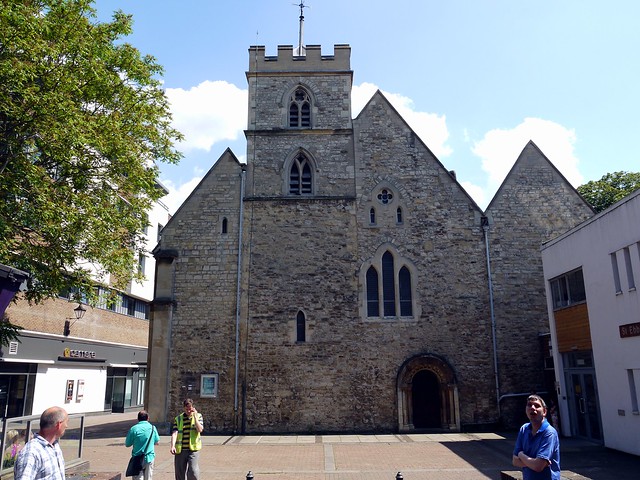
St Ebbe's Church, Oxford

The church stands on the site of one dedicated to St Æbbe before 1005. Most sources suggest that this was the Northumbrian St Æbbe of Coldingham,[1] but it has been suggested that Æbbe of Oxford was a different saint. The name was first recorded in about 1005, when the church was granted to Eynsham Abbey.[2]
The present church was built in 1814–16. It was enlarged and improved in 1866 and 1904. A fine Norman doorway of the 12th century has been restored and placed at the west end.[3] The church is a parish church for the parish of St Ebbes, a portion of which was demolished to make way for the nearby Westgate shopping centre in the 1970s. The church has a ministry amongst the remaining part of the parish, although most of its members live outside the parish.
Former rectors include Thomas Valpy French, John Arkell, Maurice Wood, John Stansfeld, Basil Gough, Keith Weston and David Fletcher.

Æbbe of Oxford


Æbbe was a saint venerated in medieval OxfordshireSt Ebbe's church in the southern English city ofOxford had been verifiably dedicated to the saint by 1091.[1] It is believed that she represents a rare southern expression of the cult of the Northumbrian abbess and saint, Æbbe of Coldingham, to whom the church at Shelswell, also in Oxfordshire, was dedicated.[2][3]
It has also been argued by several historians that Æbbe of Oxford is the same Æbbe as the conjectured abbess-saint who gave her name to nearby Abingdon ("hill of Æbbe").[4]
Notes
  1. ^ Bartlett, Miracles, pp. xiv–xv
  2. ^ Victoria County History of Oxfordshire4, 1979, pp. 369–412
  3. ^ Bartlett, Miracles, p. xv, n. 15
  4. ^ Blair, "Handlist", pp. 502–03
  5. References
  • Bartlett, Robert, ed. (2003), The Miracles of Saint Æbbe of Coldingham and Saint Margaret of Scotland, Oxford Medieval Texts, Oxford: Clarendon Press, ISBN 0-19-925922-4
  • Blair, John (2002), "A Handlist of Anglo-Saxon Saints", in Thacker, Alan; Sharpe, RichardLocal Saints and Local Churches in the Early Medieval West, Oxford: Oxford University Press, pp. 495–565, ISBN 0-19-820394-2


Acca of Hexham


Acca
Abbot & Bishop
Bornc. 660
Died20 October 740 or 742
Honored inRoman CatholicismAnglicanism;Eastern Orthodoxy
MajorshrineHexham AbbeyNorthumberland(part of cross survives)
Feast20 October

Remnant of cross that stood at the head of Acca's grave. On display at Hexham Abbey.
Acca (b c. 660 – 740 or 742), Bishop of Hexham.
Born in Northumbria, Acca first served in the household ofBosa, the future Bishop of York, but later attached himself to Saint Wilfrid, possibly as early as 678, and accompanied him on his travels. On the return from their second journey to Rome in 692, Wilfrid was reinstated at Hexham and made Acca abbot of St Andrew's monasterythere. After Wilfrid's death in 709 Acca succeeded him as bishop.
Acca tackled his duties with much energy, in ruling the diocese and in conducting the services of the church. He also carried on the work of church building and decorating started by Wilfrid. He once brought to the North a famous cantor named Maban, who had learned in Kent the Roman traditions of psalmodyhanded down from Gregory the Great through Saint Augustine.
He was also famous for his theological learning; his theological library was praised by Bede. He was known also for his encouragement of students by every means in his power. It was Acca who persuadedStephen of Ripon (Eddius) to take on the Life of St. Wilfrid, and he lent many materials for the Historia ecclesiastica gentis Anglorum to Bede, who dedicated several of his most important works, especially those dealing with Holy Scripture, to him.
For reasons now unknown Acca either withdrew, or was driven from, his diocese in 732. Some sources say he became bishop of Whithorn in Galloway, while others claim he founded a see on the site of St. Andrews, bringing with him relics collected on his Roman tour. He was nevertheless still buried at Hexham. Two finely carved crosses, fragments of one of which still remain, were erected at the head and foot of his grave.
He was revered as a saint immediately after his death. His body was translated at least three times: in the early 11th century, by Alfred of Westow, sacrist of Durham; in 1154, when the relics of all the Hexham saints were put together in a single shrine; and again in 1240. His feast day was 20 October. The translation of his relics was commemorated on 19 February.
The only surviving writing of Acca's is a letter addressed to Bede and printed in his works (see also Raine below). 

References
  • Raine, J.Priory of Hexham (Surtees Society, London 1864), containing the text of Acca's letter to Bede and other relevant material on his life
  • Stanton, Richard, A Menology of England and Wales (London, 1892), 507
  • Simeon of Durham, and Ælred's On the Saints of Hexham, both in the Rolls Series
  • EddiusLife of Wilfrid (ed Raine, J.,Historians of the Church of York, London 1879–94; ed Levison, W., in Mon. Germ. Hist.Scriptores Rerum Merovingicarum, vol. 6 (1913); or ed B. Colgrave, Cambridge 1927)
  • Bede, Ecclesiastical History of the English People (many editions)
  • Hunter Blair, P., The World of Bede (1970)
  • Kirby, D. P. (ed), St Wilfrid at Hexham (1974)

  • External links
Attribution
 This article incorporates text from a publication now in the public domainHerbermann, Charles, ed. (1913). "St. Acca". Catholic Encyclopedia. Robert Appleton Company.