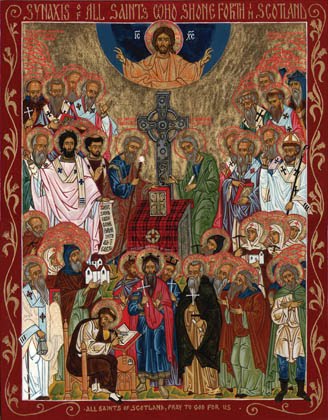
Friday, 7 September 2012

St Aebbe and Coldingham


St Aebbe and Coldingham

 
Coldingham Priory
Coldingham Priory. Photo © B Keeling
St Aebbe, daughter of King Aethelfrith of Bernicia, founded a monastery on the Berwickshire coast sometime around the middle of the 7th century. The site she selected was a fortified settlement on top of a hill overlooking the sea. Its name, in Latin, was Urbs Coludi, ‘Colud’s Fort’. Although we don’t know anything about Colud his name appears to be Celtic so he was probably a native Briton or a local god. Aebbe established a community of monks and nuns on the summit of the hill, no doubt utilising the ramparts of Colud’s Fort as a boundary. Nothing can be seen of her monastery today but the site is still known as Kirk Hill and is part of a dramatic coastal feature called St Abbs Head. Among the impressive cliffs and deep-cloven bays a large number of seabirds make their nests, hence the designation of the entire headland as a nature reserve.
St Abbs Kirk Hill
St Abbs Head: Kirk Hill (in the distance). Photo © B Keeling
In the early 680s the monastery was accidentally destroyed by fire. By then, Aebbe was already dead and her community had acquired a reputation for sleaze and scandal. After the fire the monks and nuns abandoned Urbs Coludi to join other religious houses where, we may assume, their behaviour improved. At some point in the next two hundred years a new monastery was established slightly inland, at nearby Coldingham, eventually becoming the centre of a cult devoted to St Aebbe. Little is known of its history and it possibly didn’t survive the perils of the Viking period. Whatever its fate, the religious settlement at Coldingham was re-founded in 1098 as a priory of the Benedictine Order to whom the Scottish king Edgar granted the site and surrounding district. In the 14th century a small church, an offshoot from Coldingham, was built on Kirk Hill, on the seaward side of the summit, but it almost certainly fell into disuse when the priory itself was dissolved in the 1600s.
Coldingham Priory
Coldingham Priory: foundation of tower, c.1100. Photo © B Keeling
The parish church of Coldingham now occupies part of the Priory site and is still used as a place of worship. Next to it a medieval arch has been reconstructed in the style of the 13th century, partly from old stonework and probably on its original base. On one side of the arch lie the visible foundations of a tower built c.1100, with the inscribed grave-slabs of two priors from the early 1200s placed in the centre. On the other side stands the ‘Lapidarium’, a wall erected in Victorian times using sculptured blocks and other objects unearthed at the site. Among the various interesting items in the Lapidarium are several piscinae or stone basins for washing vessels and vestments used in the Mass. One of these is thought to be a genuine 7th-century relic from St Aebbe’s original monastery on Kirk Hill.
Coldingham Priory
The presumed 7th-century piscina. Photo © B Keeling
Notes
* More about St Aebbe can be found inthis post by Michelle of Heavenfield
* I haven’t yet looked for detailed information on the ancient piscina so if anyone knows something about it please feel free to add a comment below
* Two useful links: one for the Coldingham village website, the other for the Priory
* Bede wrote about St Aebbe, her monastery at Urbs Coludi and the lax morals of its inhabitants in Book 4, Chapter 25 of his Ecclesiastical History
Coldingham Priory St Aebbe
Coldingham Priory: modern memorial to St Aebbe. Photo © B Keeling


Saint Æbbe the Elder (c. 615 – 683) founded monasteries at Ebchester and St Abb's Head nearColdingham in Scotland.

Life
Æbbe was a princess, the daughter of King Æthelfrith of Bernicia and Acha of DeiraÆthelfrith had invaded the neighbouring kingdom of Deira in 604. Assuming the throne, he united Deira with Berniciathus becoming the first king of Northumbria. To cement this claim upon Deira he took the princess Acha of the royal house of Deira as his wife. However, when Æhelfirth had invaded Deira, he deposed prince Edwin, heir to the throne and brother of Acha, who fled into exile.
Edwin took refuge in the court of King Raedwald of East Anglia, and with his support in 616, raised an army against Æthelfrith. In the subsequent battle, Æthelfrith was defeated and killed. Edwin then gained the throne of NorthumbriaEdwin on the throne meant Northumbria, was no longer safe for the children of Æthelfrith as they had a potential rival claim to the throne. Therefore when Æbbe was still young she, her mother and brothers fled north to exile in the court of King Domnall Brecc of Dál Riata. It was during this time of exile in western Scotland that she and her brothers were converted to Christianity.

[edit]Abbess

While the sons of Æthelfrith always represented a threat to Edwin, he was finally deposed by an alliance of the Mercian King Penda and the Welsh King Cadwallon. They raised an army againstEdwin and killed him in battle in 633. Eanfrith, eldest son of Æthelfrith, and Æbbe's half-brother, returned as King of Bernicia, however he was double-crossed and murdered by Cadwallon. The year following Æthelfrith's son Oswald returned and drove the invaders from both Bernicia and Deira, thus establishing himself on the throne of Northumbria. He was however defeated and killed in battle, in 642, by Penda of Mercia, and was succeeded as King by his brother Oswiu.
With her brothers on the throne of Northumbria, Æbbe could return from exile and with their support established a monastery at Ebchester and later at urbs Coludi, now known as Kirk Hill at St Abb's Head, latterly evolving into Coldingham Priory. This religious house lasted for about 40 years and was a double separate monastery of both monks and nuns governed by Æbbe. Legend says she became a nun to avoid the attentions of a certain Prince Aidan. However, he refused to give up his suit and it is said that due to her prayers the tide stayed high around Kirk Hill for three days and protected her.
Æbbe was a great teacher and politician, bringing Christianity to the then pagan Angles who had been settling along the east coast of Britain since the 5th century. She educated the ex-queen Ætheldredafirst wife of Ecgfrith, who later after graduating from Æbbe's tutelage established a religious site on which now stands Ely Cathedral.
Her political prowess also proved important in rectifying a dispute between the then King ofNorthumbria, her nephew Ecgfrith, who had succeeded his father Oswui in 670, and the Bishop Wilfrid. The dispute started with Wilfrid's support for Queen Ætheldreda, who wished despite her marriage to preserve her virginity, and to enter a monastery. With his support she had become a nun at Æbbes monastery. The ill feeling in court against Wilfrid continued with Ecgfrith's second wife, Iurmenburh, who became hostile to Wilfrid on account of the vast estates which he had acquired and the way he travelled about with a large armed retinue, like that of a king. This culminated in Wilfrid being imprisoned at Dunbar at Ecgfrith's whim. Thanks to Æbbe's political skills, on a visit by Ecgfrith to the monastery on Kirk hill, she managed to persuade her nephew to release the bishop.
The reality of life in the early Christian establishment was not always strict on sexual piety. Due to the noble background of members of the religious community, the monastery would also have been a place for eating, drinking and entertainment. While Æbbe, herself was noted for her own piety, she had trouble enforcing discipline at the monastery. The monks and nuns thus became very lax and worldly. This leads to one of the most famous miracles surrounding the patron saint of southeast Scotland and northeast England, St. Cuthbert who visited Æbbe's monastery to instruct the community. At nightCuthbert would disappear to bathe and pray in the sea, to stop himself succumbing to temptations of the flesh. Very early one morning, a monk from the monastery spied him praying and singing psalms in the sea and as Cuthbert came ashore, he saw or imagined he saw two otters bound out of the sea and join Cuthbert. The most likely location for this event is Horse Castle bay at the base of the Kirk Hill.
Death
Shortly after the death of Æbbe, and as foretold in prophesy by the monk Adamnan, in 683 the monastery burned down. The monastic site was abandoned, and by the first half of the 8th century, asBede confirms, the site was deserted. The early work of Æbbe in establishing the Christian religion in south east Scotland was not forgotten, and in a book written about c.1200 by the monks of Coldingham, they tell of many pilgrims visiting the Kirk Hill and the spring at Well Mouth, located at the top of the beach now called Horse Castle Bay. St. Æbbes feast day is celebrated on 25 August.
References

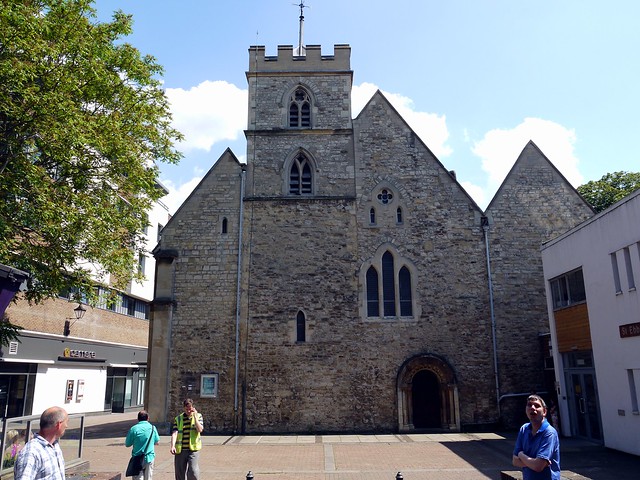
St Ebbe's Church, Oxford-Æbbe of Oxford


photo

St Ebbe's Church, Oxford

The church stands on the site of one dedicated to St Æbbe before 1005. Most sources suggest that this was the Northumbrian St Æbbe of Coldingham,[1] but it has been suggested that Æbbe of Oxford was a different saint. The name was first recorded in about 1005, when the church was granted to Eynsham Abbey.[2]
The present church was built in 1814–16. It was enlarged and improved in 1866 and 1904. A fine Norman doorway of the 12th century has been restored and placed at the west end.[3] The church is a parish church for the parish of St Ebbes, a portion of which was demolished to make way for the nearby Westgate shopping centre in the 1970s. The church has a ministry amongst the remaining part of the parish, although most of its members live outside the parish.
Former rectors include Thomas Valpy French, John Arkell, Maurice Wood, John Stansfeld, Basil Gough, Keith Weston and David Fletcher.

Æbbe of Oxford


Æbbe was a saint venerated in medieval OxfordshireSt Ebbe's church in the southern English city ofOxford had been verifiably dedicated to the saint by 1091.[1] It is believed that she represents a rare southern expression of the cult of the Northumbrian abbess and saint, Æbbe of Coldingham, to whom the church at Shelswell, also in Oxfordshire, was dedicated.[2][3]
It has also been argued by several historians that Æbbe of Oxford is the same Æbbe as the conjectured abbess-saint who gave her name to nearby Abingdon ("hill of Æbbe").[4]
Notes
  1. ^ Bartlett, Miracles, pp. xiv–xv
  2. ^ Victoria County History of Oxfordshire4, 1979, pp. 369–412
  3. ^ Bartlett, Miracles, p. xv, n. 15
  4. ^ Blair, "Handlist", pp. 502–03
  5. References
  • Bartlett, Robert, ed. (2003), The Miracles of Saint Æbbe of Coldingham and Saint Margaret of Scotland, Oxford Medieval Texts, Oxford: Clarendon Press, ISBN 0-19-925922-4
  • Blair, John (2002), "A Handlist of Anglo-Saxon Saints", in Thacker, Alan; Sharpe, RichardLocal Saints and Local Churches in the Early Medieval West, Oxford: Oxford University Press, pp. 495–565, ISBN 0-19-820394-2


Acca of Hexham


Acca
Abbot & Bishop
Bornc. 660
Died20 October 740 or 742
Honored inRoman CatholicismAnglicanism;Eastern Orthodoxy
MajorshrineHexham AbbeyNorthumberland(part of cross survives)
Feast20 October

Remnant of cross that stood at the head of Acca's grave. On display at Hexham Abbey.
Acca (b c. 660 – 740 or 742), Bishop of Hexham.
Born in Northumbria, Acca first served in the household ofBosa, the future Bishop of York, but later attached himself to Saint Wilfrid, possibly as early as 678, and accompanied him on his travels. On the return from their second journey to Rome in 692, Wilfrid was reinstated at Hexham and made Acca abbot of St Andrew's monasterythere. After Wilfrid's death in 709 Acca succeeded him as bishop.
Acca tackled his duties with much energy, in ruling the diocese and in conducting the services of the church. He also carried on the work of church building and decorating started by Wilfrid. He once brought to the North a famous cantor named Maban, who had learned in Kent the Roman traditions of psalmodyhanded down from Gregory the Great through Saint Augustine.
He was also famous for his theological learning; his theological library was praised by Bede. He was known also for his encouragement of students by every means in his power. It was Acca who persuadedStephen of Ripon (Eddius) to take on the Life of St. Wilfrid, and he lent many materials for the Historia ecclesiastica gentis Anglorum to Bede, who dedicated several of his most important works, especially those dealing with Holy Scripture, to him.
For reasons now unknown Acca either withdrew, or was driven from, his diocese in 732. Some sources say he became bishop of Whithorn in Galloway, while others claim he founded a see on the site of St. Andrews, bringing with him relics collected on his Roman tour. He was nevertheless still buried at Hexham. Two finely carved crosses, fragments of one of which still remain, were erected at the head and foot of his grave.
He was revered as a saint immediately after his death. His body was translated at least three times: in the early 11th century, by Alfred of Westow, sacrist of Durham; in 1154, when the relics of all the Hexham saints were put together in a single shrine; and again in 1240. His feast day was 20 October. The translation of his relics was commemorated on 19 February.
The only surviving writing of Acca's is a letter addressed to Bede and printed in his works (see also Raine below). 

References
  • Raine, J.Priory of Hexham (Surtees Society, London 1864), containing the text of Acca's letter to Bede and other relevant material on his life
  • Stanton, Richard, A Menology of England and Wales (London, 1892), 507
  • Simeon of Durham, and Ælred's On the Saints of Hexham, both in the Rolls Series
  • EddiusLife of Wilfrid (ed Raine, J.,Historians of the Church of York, London 1879–94; ed Levison, W., in Mon. Germ. Hist.Scriptores Rerum Merovingicarum, vol. 6 (1913); or ed B. Colgrave, Cambridge 1927)
  • Bede, Ecclesiastical History of the English People (many editions)
  • Hunter Blair, P., The World of Bede (1970)
  • Kirby, D. P. (ed), St Wilfrid at Hexham (1974)

  • External links
Attribution
 This article incorporates text from a publication now in the public domainHerbermann, Charles, ed. (1913). "St. Acca". Catholic Encyclopedia. Robert Appleton Company.

Wednesday, 22 August 2012

IONA ORTHODOX RETREATS


under the Patronage of
 His Eminence Archbishop Gregorios of Thyateira     and the
 Chairmanship of  His Excellency Metropolitan Kallistos of Diokleia.
_____________________________________________________________________

GLORY TO GOD!

There  will  be  a  temporary                 IONA ORTHODOX CENTRE         at  CLACHANACH

for   a  fortnight  in  both 
Spring and Autumn 2012
The dates are: 

Saturday 28th April - Saturday 5th May
Saturday 5th May - Saturday 12th May
and
Saturday 15th September - Saturday 22nd September
Saturday 22nd September - Saturday 29th September

You   are  invited  to  make  your   individual  Pilgrimage/Retreat   during  any  of   these  weeks.

It is expected that there will be an Orthodox Priest resident for much of this time.


5  minutes  from  the  Abbey  and  from  St.  Oran's  Chapel.

The 12th Century ST. ORAN'S CHAPEL; oldest building on Iona.

THE   ISLE   OF   IONA   -  a  beautiful and  sacred  place

Colum Cille - St. Columba - came to Iona from his native Ireland about 563 A.D.
From Iona, Columba and his monks spread Celtic Christianity through North Britain.

They were in communion with all Orthodox Christians.

If  you  would  like  to  become  part  of  a temporary  Orthodox  Community  on  Iona
for  a  week;
to  make  a  private  retreat  or  an  individual  pilgrimage,
or  simply  to  enjoy  the  peace  and  tranquillity  of  Iona

...   where  the  veil  between  Heaven  and  Earth  grows  very  thin ...

      then please contact   as  soon  as  possible:
     
- if interested in April-May Retreats - 

Reader Ignatios Bacon,
Oratory  of  the Theotokos  and  St.  Cumein,
Kilchuimen/Fort Augustus,  Scotland   PH32 4DG
Telephone:   01320 366457


     If your interest is in a September Retreat -

Fr. Mark McBeth,
35 Buchanan Drive,
Burnside,
Glasgow
G73 3PF

Tel. 0141 647 2728 and
0787 2536 105

 
The September retreats will be led by Fr. David Gill

_____________________________________________________________________

THREE  RECENT  EXPERIENCES  OF  IONA

Long journey, rough sea crossing, arrival exhausted on a beautiful atmospheric island. The welcoming house with good food and regular morning and evening worship in the local old chapel.
The beauty of the island when the sun shone was breathtaking, and even mystical in the rain. 
A wonderful visit for reflection, renewal, rest and company. I long to go again. 

Margaret Handley
Mar 16 2012


I had waited many years to fulfil my ambition of going to Iona but when Iona Orthodox retreats offered me the opportunity of doing so, it did not disappoint. There is a painting by John Duncan, 'Saint Columba Bidding Farewell to the White Horse', where the horse, sensing the Saint's impending death, comes to see him for the last time. For me, this captures precisely the spirit of Iona: the oneness of spirituality and nature.

At Matins and Vespers in Saint Oran's Chapel, the prayers are accompanied by House Martins darting in and out of the chapel door to their nest in the rafters.

Having walked to Saint Columba's Bay, the tranquillity was broken by a sense that I was being watched. Looking out to sea I found I was being observed by a sealwhich had surfaced just offshore. It dived and surfaced to stare at me , dived and surfaced before it returned to the sea and I turned to retrace my steps. 

I found Iona to be a place with a unique form of peacefulness which invites and encourages contemplation and prayer. I returned to the mainland, with its bustle and distractions, with a host of memories but also physically revitalised and spiritually refreshed.

Martin Stone


I spent a few days on Iona last Autumn.  I found it to be a very peaceful place.  It was really getting one to one with nature with the grass and the sheep and the cows, which were all really laid back.  On the way over, I had never seen so many rainbows in my life.  I met some lovely people in the Orthodox retreat house and St. Orans Chapel was a good setting for the prayer services. 

Charlotte Anna

Our Patron


OUR VENERABLE AND GOD-BEARING FATHER COLUMBA OF IONA, ENLIGHTENER OF SCOTLAND (521-597)

St. Columba Fr. Peter Preble Fr. John A. PeckSaint Columba (the Latinized name for Colum, meaning dove) was born at Garten in Donegall to a noble family. He entered the monastic school of Moville under Saint Finnian, who had studied at Saint Ninnian’s great monastery. Here Columba received the diaconate and entered monastic life. Tradition tells us that it is there that his sanctity is first attested to by the performance of miracles. Having completed his training he travelled to Leinster and then later to the monastery of Clonard. Here he was probably ordained priest before leaving for Glansnevin and the monastery there. When a pestilence devastated the country in 543, the monks dispersed and Columba spent 15 years traversing in Ireland founding several important monasteries, including Derry in 546. Sometime around 560, he became involved in a dispute with Saint Finnian over a psalter. Columba had copied a psalter and believed he had the right to keep it, Saint Finnian did not.
In 563 Columba, with twelve companions, left for Scotland. The reasons given for this departure vary but it is probable that he was involved in encouraging clan warfare against King Diarmait in 561, with some connection to the psalter dispute. On the Island of Iona he founded the famous Abbey, a centre for Celtic Christianity. Iona became a base for missionary work amongst the Northern Picts. Columba visited King Bridei, near Inverness, and won his respect. The royal residence had been bolted closed but, at the sign of the cross, the doors flew open and thus struck by such a miracle, the King listened and was baptised. Many of the people soon followed. This respect he found subsequently led him into a political role and he helped greatly in shaping the political landscape of that time, with some opposition remaining from the Druids.
Columba spent the rest of his life preaching and travelling in Scotland. The ‘Book of Deer’ (a tenth century illuminated manuscript, providing a unique insight into cultural, social and ecclesiastical life of the East of Scotland.) attests to Columba’s work and miracles in the East of the country. On another journey to the West he met with Saint Mungo, the apostle of Strathclyde. He returned to Iona, when not engaged in missionary work, and there many came to seek his counsel. From here, Columba governed the many communities he had founded. In the Celtic tradition the Abbot, although perhaps only in priest’s orders, was at times considered to govern above that of the position of a bishop, the bishop thus being subject to the Abbot’s jurisdiction.
On the afternoon of 8th June, 597, Columba climbed the hill behind his monastery and gave his final blessing to the place he loved so much. At vespers, that night, he collapsed before the altar and found home with his heavenly Father, surrounded by his monks. He was seventy six years of age. He was buried in the monastery but, one hundred years later, his bones were disinterred and revered. They were taken to Ireland when the threat of Vikings became apparent but they vanished in time. Books and garments remained at Iona Abbey and were the focus for miraculous works.
Saint Adamnan, a future Abbot of Iona, said of Columba
“He was angelic in appearance, graceful in speech, holy in work”.
It is without doubt that Columba stands as one of the greatest of the Celtic Saints. A man of incredible industry, of missionary work, of creating communities and not least a man of humility and deep charity.

Saturday, 14 July 2012

Holy Confessor, Saint Donald of Ogilvy, Scotland († 8th c.)


Saint DonaldCOPYRIGHTED ART. Do not copy or deep-link to without prior permission from "COME AND SEE" Icons, Books & Art.
July 15th
St. Donald lived in Olgilvy in Forfarshire, Scotland. He and his wife had nine daughters. On the death of his wife, Donald and his nine daughters formed a kind of monastic home.  On his death, the daughters entered a monastery in Abernathy. St. Donald reposed circa 716.

Friday, 13 July 2012

Saint Constantine of Cornwall, Abbot, Martyr († 576 or 588)


Our holy Father Constantine was, according to one tradition, the nephew of the famous King Arthur, to whom the latter bequeathed his crown when he was mortally wounded.
According to another, he was a king of Cornwall who abandoned his kingdom and became a monk in St. David's cell. Then, leaving for another land, he built a monastery there.
The fullest traditions concerning him come from Scotland. They state that he was the son of Paternus, king of Cornwall, and married the daughter of the king of Brittany. But she died, and he, grieving over her death and refusing to be comforted, delivered his kingdom to his son, and bidding farewell to all, left his kingdom and crossed over to Ireland.
Coming to a certain monastery, for seven years he worked humbly carrying grain to and from the monastery mill. One day he was sitting in the mill and said to himself; "Am I Constantine, king of Cornwall, whose head has so often worn the helmet and his body the breastplate? No, I am not." A man who was hiding in the mill overheard this and reported it to the abbot.
He then took him away from the mill, educated him, and raised him to the priesthood. Soon after this, he left the monastery and went to St. Columba; and afterwards he was sent by St. Kentigern, the bishop of Glasgow, to preach the word of God in Galloway, in South-West Scotland. There he was elected abbot of a monastery, where he lived a holy life until old age. According to another tradition, he founded a monastery at Govan on the Clyde. In his extreme old age, St. Constantine prayed God to give him a martyr's death, and he heard a voice from heaven saying that it should be as he had asked. Then he went preaching the word of God throughout the land, and came eventually to the island of Kintyre. There some evil men followed him, and, coming up to his attendant, they cut off his hand. The saint immediately healed him with a touch.
Then the evil men showered blows upon the saint, cut off his arm, and left him for dead. Calling the brethren to him, the saint comforted them with spiritual words. Then he fell asleep in their presence.
St. Constantine was martyred, according to the Scottish tradition, in 576, and according to the Irish tradition in 588.
His feast day is March 9 in Wales and Cornwall, March 11 in Scotland and March 18 in Ireland.

Source: http://en.wikipedia.org/wiki/Saint_Donnan